

One year into our AI journey
To
our community
and those racing to catch up,
When I joined Cars24 about a year ago to rebuild our AI efforts, our early conversations were honest, but uneasy. We could feel a platform shift happening in real time. We knew we were at a moment in history where we either had to rebuild early, or end up rebuilding later under existential pressure.
We were, and are, paranoid. We know that tomorrow, two kids in a garage could build an AI-first competitor from the ground up and try to drive us out of business. We’ve seen this exact story play out across the tech industry recently, where giants with massive distribution are suddenly beaten by young, agile teams moving at the speed of thought. But that paranoia forced a clarifying question: if those two kids beat us, would it be because their operating expenses were lower? Or would it be because their customer experience was fundamentally better?
At the time, it was tempting to equate activity with strategy. We had already tried a few experiments, including a discovery chatbot we built months earlier. It sounded smart, tested well in a demo, and then quietly failed to move the metrics that actually mattered. That failure was incredibly useful because it taught us that we could not run a hundred disconnected pilots and call it an AI strategy. AI could not be a vanity metric or a feature we sprinkled on top of old workflows.
If it was going to reshape Cars24, it had to be customer-backwards. We realized that if we do the hard work of making the journey meaningfully better for the customer, operational efficiency and business growth will naturally follow as outputs.
Features vs. Foundations
But taking a customer-backwards approach in our industry is uniquely difficult. Buying a car is not like buying a phone charger or a pair of shoes. It is a highly emotional, deeply meaningful moment. It requires deep thought, big feelings, and a massive financial commitment. It differs drastically from the high-frequency, low-stakes e-commerce transactions for which most generic AI products are built.
Because of that emotional weight, we knew that off-the-shelf AI tools wouldn't cut it. No generic product could solve for the specific anxiety of a car buyer or the nuanced complexity of a physical vehicle inspection. No one understood our business or our customers' needs better than we did. So, we made a rule: if a problem truly mattered to our customers, we would not just bolt AI onto the existing process. We would rebuild the experience from scratch, with AI as the foundation.
To do that, we had to change who was actually doing the building. It had to be us. Historically, AI has been treated as a dark art. It lived in air-conditioned rooms, guarded by AI scientists and product managers who understood the math but were disconnected from the daily grind of the business.
But customer obsession doesn't happen in an AC room; it happens on the ground. We realized that if AI was going to be our operating system, it had to become muscle memory for everyone.
Our Tech and AI teams could not be the bottleneck; they had to become enablers; their work had to be to build tools and platforms for AI Workflows so deeply connected to our ecosystem that anyone could deploy them across their domain instantly. We shifted the onus of building agents and workflows to the customer-obsessed business, operations, and frontline folks. We taught our teams that a "prompt" isn't a magical incantation. A prompt is simply our on-ground reality and operational playbooks, codified in a way a reasoning engine can understand.
Building this way requires a different metabolism. We cannot afford to stay at the drawing board for months waiting for perfect clarity while the technology accelerates daily. We decided to run lean, break things safely, and learn in days, not quarters.
That was the philosophy. The next step was turning that philosophy into an operating system. To do that, we looked at the critical moments in our journey and asked: where is trust most fragile?
Targeting the customer trust flywheel
Before we could rebuild those fragile moments, we had to be honest about the technology itself. LLMs and foundational models are, in many ways, rudimentary black boxes. When your entire business is built on trust, you cannot afford to hand your customer experience over to a black box you don’t fully understand.
We knew we could n't afford to get this wrong. So, instead of just buying off-the-shelf APIs and treating AI companies as generic vendors, we chose to build deep, co-building partnerships with the absolute best in the world. By forging close ties with pioneers like OpenAI and ElevenLabs, we became one of their earliest deep enterprise partners in India. We wanted to build with them, anticipating where the technology was, rather than just reacting to what it could do today.
With that foundation in place, we looked at the first place trust breaks down: the conversation. Buying or selling a car is not a silent, add-to-cart checkout process. It is a highly assisted, deeply considered decision where almost 70 percent of our entire funnel relies on human interaction. But more than that, it is an opportunity. Every conversation is a chance to alleviate fear. India is a voice-first market; trust is earned over the phone. When a customer applies for a car loan, a one-hour delay isn't just an annoyance, it's agonizing financial anxiety. When a channel partner tries to procure a vehicle, a delay is food off their table.
We realized that if we could overhaul our conversational experience, not to deflect our customers with cheap bots, but to instantly, empathetically resolve their highest-anxiety questions, we wouldn't just be saving time. We would fundamentally alter the trust equation. We then looked at the physical metal. We hear countless stories from customers about how parting with their vehicle feels like saying goodbye to a member of the family. There is a profound, almost invisible emotional attachment. Yet, traditionally, inspecting and pricing that car has been a closed system, driven entirely by the subjective gut-feel of an individual mechanic. A customer nervously watches an inspector poke around their car, only to be handed a price from on high. It feels arbitrary. We had to make the subjective, undeniably objective. We targeted the inspection process to replace gut-feel with consistent, explainable truth, offering total transparency to the seller.
But standardizing the condition of the car is only half the battle. Even with a perfect inspection, a seller will still walk away if the final price feels like a guess pulled out of thin air. Mist rust thrives in ambiguity. To eliminate that doubt, we had to eliminate the ambiguity of the market itself. We realized we needed to map India's entire vehicle universe down to the pin code. We wanted our pricing to be driven not by a hidden algorithm, but by undeniable, hyper-local truth. When a seller hands us their keys, they should n't have to wonder if they got a fair deal, they should know exactly why their car is worth what it is.
And that promise of trust has to survive the transition from the digital screen to the real world. When we looked deeply at the customer’s journey, we realized the physical handoff is where anxiety truly peaks. A beautiful app and a seamless loan approval mean absolutely nothing if the car is delayed, lost, or mishandled in a chaotic refurb yard. The emotional high of buying a car is incredibly fragile at that exact moment. Our intent in focusing so heavily on our physical hubs wasn't driven by a desire for backend logistical efficiency; it was a strictly customer-obsessed need to protect that emotional high.
We had to ensure that the feeling of trust built online wasn't instantly broken by a failure in the parking lot.
Looking inward: Rebuilding our internal engine
Finally, we looked inward. To manufacture trust for our customers, we had to elevate the people building it. We spend a massive amount of our time obsessing over who we welcome into the Cars24 family. Why? Because the person picking up the phone, or inspecting a car in the sun, inherently is Cars24 to our customer. They inherit the responsibility of trust. We realized that if we want deeply empathetic, high-quality people on our frontlines, our hiring process could n't be a cold, mechanical filter. We needed a way to screen for empathy and capability at scale, ensuring every hire could carry the weight of that trust faster and more fairly.
We turned that same emotional lens on our engineers. We don't want a tech team of exhausted code-writers mechanic ally closing Jira tickets. We want passionate product builders. We realized we needed to remove the friction of repetitive syntax and mandatory checks.
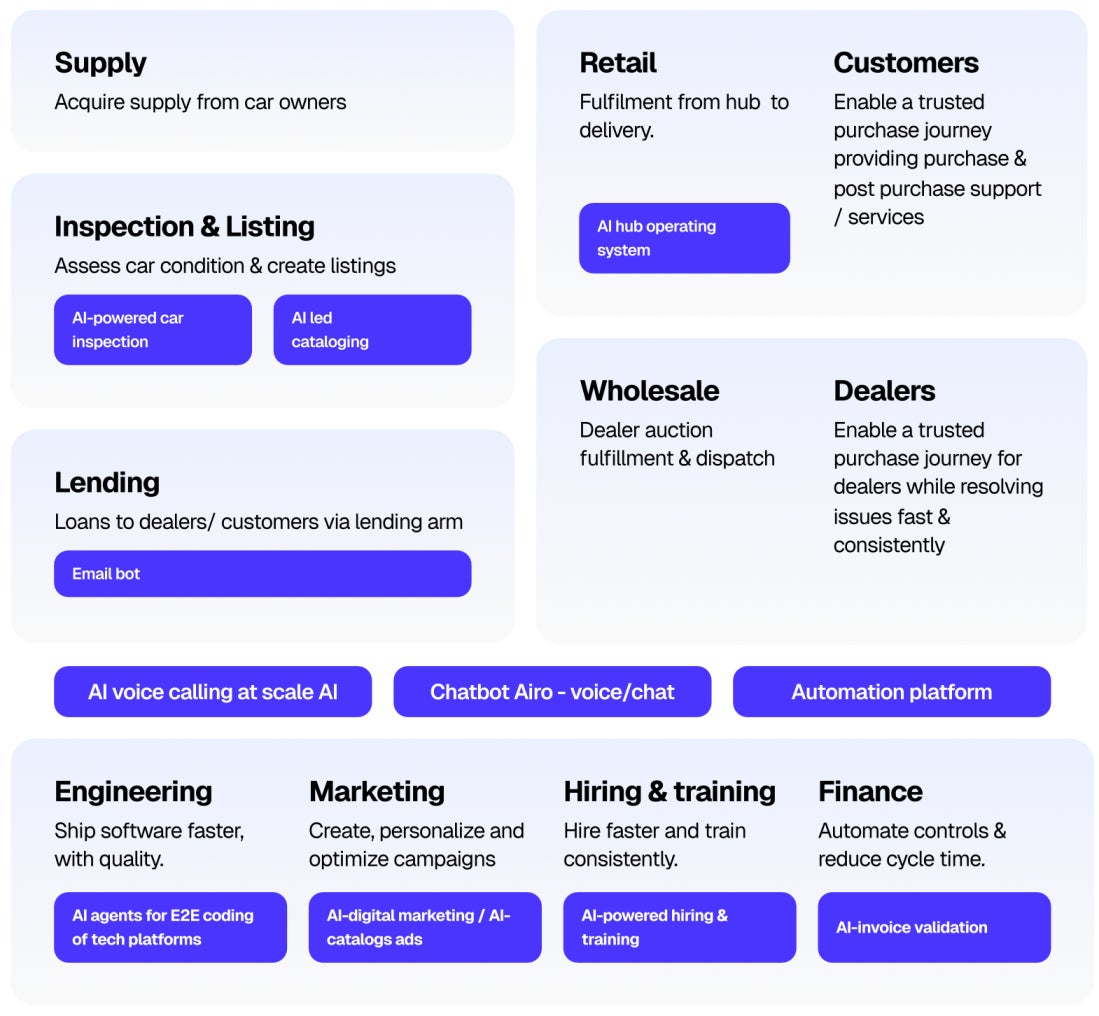
Our intent was to free their minds, allowing them to focus entirely on solving the customer' s most complex, emotionally resonant problems. But we quickly realized something profound. The desire to build better experiences wasn't just sitting in the Engineering department. Our business heads, our yard managers, and our frontline operators, they saw the friction everyday and they passionately wanted to solve it. They had the intent. We made a defining cultural choice : AI wouldn't just be a toy locked away for the tech team. We had to turn our employees from mere users of technology into builders of it.
Our goal was to democratise intelligence across the entire company. We wanted to give every single employee the exact same intelligence and the ability to codify their on -ground reality without bottlenecks. We did n ' t just want to move fast; we wanted to give our people the ultimate leverage to do the most meaningful work of their lives. We knew what we had to rebuild, and why it mattered. Over the last 12 months, we actually built it.
The impact: Systems of trust at scale
Building systems that truly solve problems in the physical world is incredibly complex. It requires looking at the entire value chain, from the moment a customer thinks about selling their car, to the financing, to the physical handoff in our yards. Over the past year, we stopped looking at AI as a series of isolated "features" and started building an interconnected operating system.
When you orchestrate these systems correctly, the compounding surplus for the customer is massive.
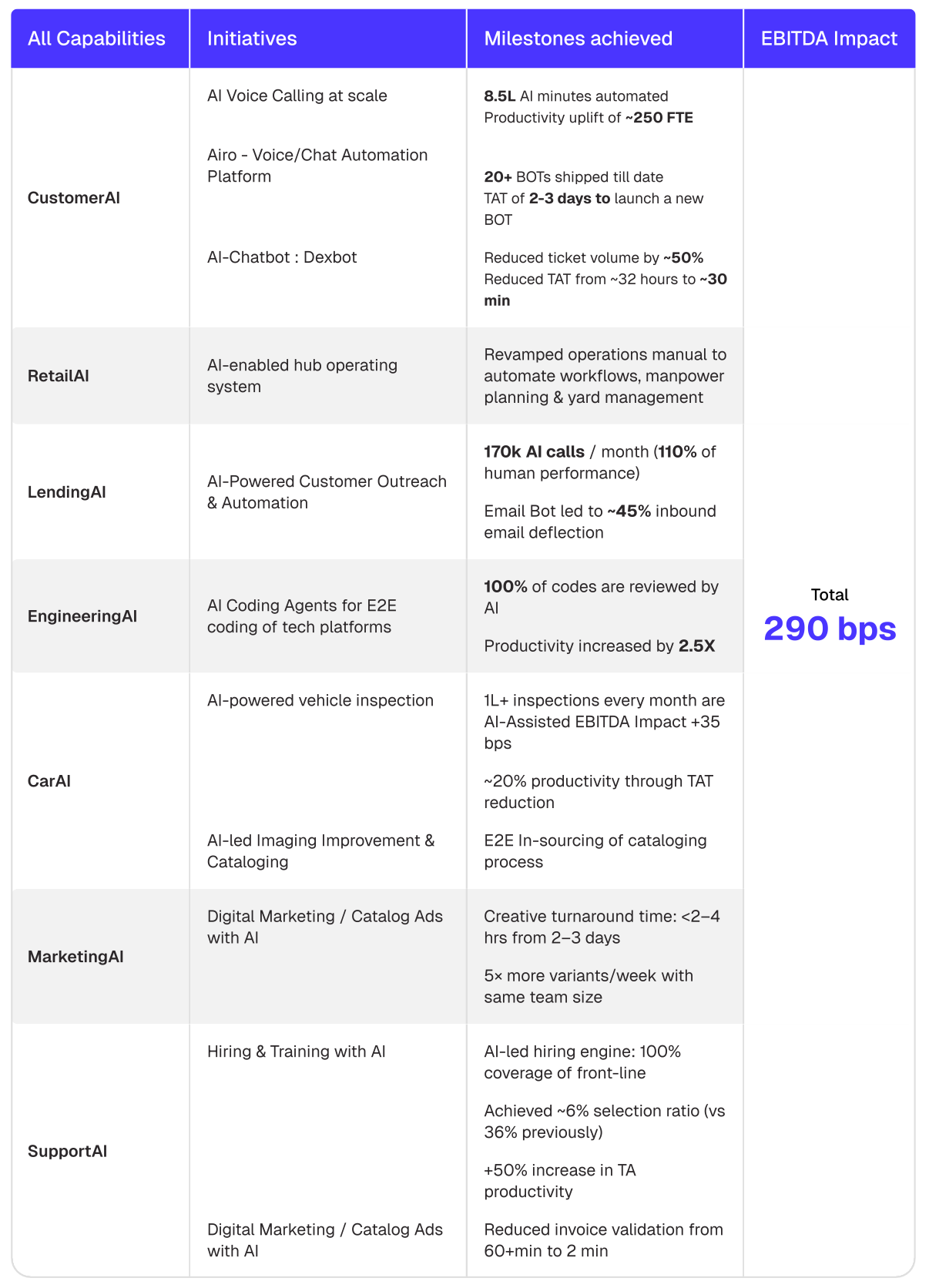
Orchestrating the conversation: We knew we could n't just buy an off-the-shelf chatbot to talk to our customers. To build real empathy into digital conversations, we built our own proprietary agent platform, Airo. This allowed us to deploy over 20 highly specialized AI voice and chat bots across our entire ecosystem in a matter of days.
The scale of this shift has been phenomenal. Today, an astounding 20% of our entire conversational volume is completely handled by our in-house Voice AI stack. These agents handle over 8.5 lakh minutes of automated voice calling and 170,000 finance outreach calls per month. But we aren't just deflecting calls; we are resolving them with deep empathy. Our AI agents operate at 95% to 105% of human performance parity.
What we are seeing on the ground is that customers are happy, they feel heard, and they trust the information they are given. We don't use AI to simply "assist" our customers; we use it to instantly resolve their anxiety.
By deploying our Dealer Experience Bot and Email bots, we reduced manual ticket volumes by 50%, but more importantly, the turnaround time for our channel partners plummeted from a frustrating 32 hours down to just 30 minutes. Our Voice AI can seamlessly handle multiple local languages and field any concern. It has infinite patience, it answers questions objectively, and it responds in mere seconds. For the customer applying for a loan, their wait time went from agonizing hours to absolute zero. We did n't just automate calls; we automated trust.

Codifying the physical world: To remove the mystery of vehicle valuation, we rebuilt our inspection architecture from the ground up. We didn't just train a simple image-recognition tool; we deployed a family of 20 in-house, custom-trained AI models. And we did n't spin these up overnight, they are built on the foundational ground truth of over a million physical inspections we have painstakingly conducted over our 10-year journey.
Today, we conduct over 100,000 AI-assisted vehicle inspections every month. By relying on this deep data moat, we brought the error rate down to less than 5%, entirely removing human subjectivity from the assessment of scratches, dents, and rust. This technology allowed us to cut the physical inspection time in half, dropping it from a grueling 50 minutes down to just 25 minutes. But more importantly than the time saved, it allowed us to look a seller in the eye and give them a price backed by undeniable, mathematical truth, not a mechanic's guess.
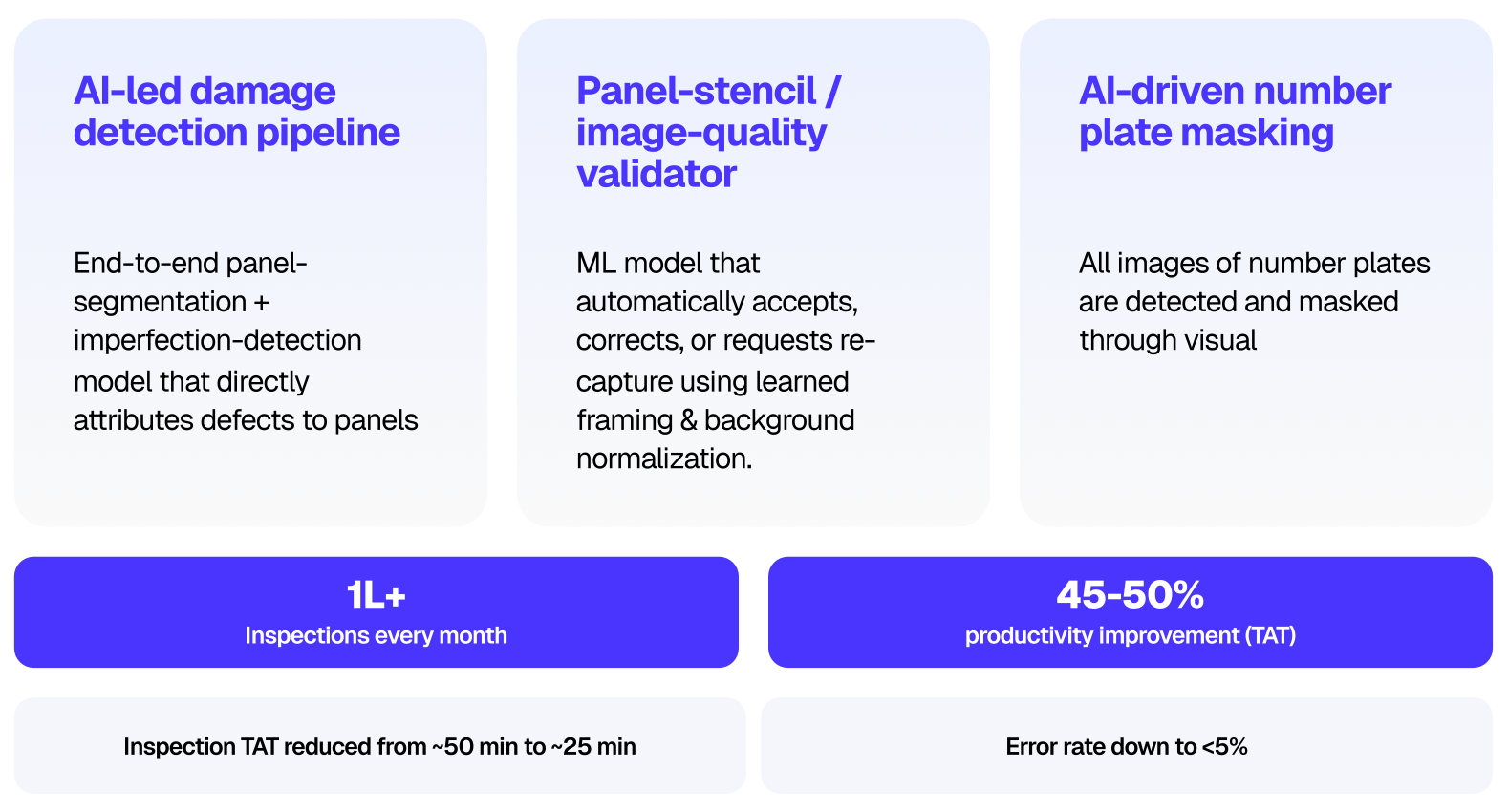
But creating trust also means ensuring the digital representation of that car is breathtakingly accurate. Through Visio, our in-house AI imaging and cataloging pipeline, we completely overhauled the visual experience of car buying. We wanted the experience of looking at our cars online to be beautiful, consistent, and completely transparent, ensuring that what a buyer falls in love with on their screen is exactly what arrives in their driveway.
But standardizing the car isn't enough if the physical handoff is chaotic. We mentioned earlier how fragile the emotional high of buying a car is when a customer arrives at our physical hubs. To protect that emotion, we built Project Trident. Trident isn't just a reporting dashboard; it is an AI-enabled operating system for the physical world. By centralizing yard management, standardizing 35+ daily checkpoints, and utilizing real-time video analytics, we brought total predictability to our refurb yards. We ensured that the digital promise of a perfect car is matched by a flawless, deeply reassuring physical reality.
A public commitment to safety: We believe our responsibility to the automotive ecosystem extends far beyond our own customers. In partnership with the Crashfree India initiative, we recently deployed India ’s first AI-powered road-safety billboard. Using edge-based AI for real-time license plate recognition, we instantly notify passing drivers of their vehicle's compliance status, such as pending challans or expired insurance, in under 10 seconds. We built this because our visibility on the streets needs to prove that Cars24's commitment to safety is a core responsibility to the community, not just a marketing slogan.
Democratizing the reasoning engine: We believe that to serve our customers better, general intelligence cannot just live inside our proprietary software, it has to be in the hands of every single employee. In deep partnership with OpenAI, we rolled out ChatGPT Enterprise across Cars24. We did n't give it to them as a novelty; we gave it to them as a daily reasoning engine to augment their thought process, speed up their decision-making, and remove administrative friction.
The adoption has been explosive. Today, we are seeing over 85% daily active users (DAU) on ChatGPT across our workforce, and that number continues to climb. We are cultivating a team of builders who use AI to solve their own operational bottlenecks every single day. For instance, our Procurement Head in Finance was exhausted by vendor payments constantly getting delayed due to the manual validation of complex invoices across multiple cloud accounts. Instead of filing a Jira ticket and waiting months for engineering support, she used AI to build her own cost-validator platform. Today, that platform validates complex AWS invoices in under two minutes with zero human intervention. She saw a problem, and she built the solution.
Supercharging the builders: We turned that same leverage toward our engineering teams. We wanted to free their minds from policing syntax so they could focus on solving complex architectural problems for our customers. Today, 100% of our code is reviewed by AI, and over 25% of our code in production is entirely generated by it.
The compounding effect of this leverage is staggering. By integrating AI pair-programming directly into their workflows, we are seeing our top engineers fundamentally warp time, effectively delivering 384 hours of development work in a single week. Furthermore, we have built several internal platforms powering our core web and app experiences that successfully manage 100% of that specific traffic, where our engineers wrote absolutely zero lines of code.
We applied this same rigorous leverage to how we build our human teams. By deploying an AI-led screening engine for our frontline hiring, we radically refined our talent funnel, dropping our selection ratio from an inefficient 36% down to a highly targeted 6%. Coupled with AI-led training and 100% call- quality monitoring, we drove a 50% productivity boost in talent acquisition and a sharp drop in voluntary attrition. Our people are no longer overwhelmed by process; they are elevated by intelligence.
The compounding output: When you rigorously align technology with the customer ’s deepest needs, when you use AI to eliminate anxiety, remove ambiguity, and empower your employees to move at the speed of thought, the financial results take care of themselves.
Over the past 12 months, this integrated, system-wide AI deployment didn't just improve our customer experience; it fundamentally altered our unit economics. Across customer, retail, finance, tech, and marketing, these changes have collectively driven an EBITDA margin uplift of over ~290 basis points. This is the power of a customer-backwards AI strategy. It is not a cost-cutting exercise; it is a profound expansion of value.
The road ahead: Rebuilding for a modern world
While the impact over the last 12 months has been staggering, the reality is that we are barely scratching the surface. We feel as though we are running in a race that is accelerating daily.
One of the lessons you learn when building deeply complex systems is that to ensure they endure, you must invest in the long term. And sometimes, that means you have to start over. We are currently rebuilding Cars24 from the ground up, with AI natively woven into every single interaction. Our recent brand identity evolution is not just a fresh coat of paint; it is the public signal of this profound internal transformation. It is our declaration that AI is now at the absolute center of our modern world, and it has become the fundamental muscle memory of this company.
As we look to the next few weeks and months, we are not just doubling down; we are tripling down on our AI conviction.
Here is what the frontier looks like for Cars24 –
The collapse of time and the evolution of the builder: We are changing the very physics of how we operate. We will no longer measure our development cycles in months or weeks; we are shifting to days, and soon, to hours.
As AI takes on the heavy lifting of writing the majority of our code, the traditional silos
between Product Managers, Designers, and Engineers are beginning to blur. Our engineers are no longer just writing syntax; they are leveling up to become Architects. They are designing massive, interconnected systems of intelligence. We are fostering an environment where anyone with customer empathy and a clear vision can build the solution.
The new "AI-first" SaaS mandate: This builder mentality is radically shifting how we view our external software dependency. Moving forward, we are looking at every single third-party tool and SaaS platform we use and asking a simple, brutal question: Is this AI-First, or is AI just bolted on? If a platform is treating AI as a marketing gimmick rather than a foundational architecture, we will drop them. Our strategy is clear: we will significantly reduce our legacy SaaS OPEX because we will either move those capabilities to our own in-house AI builders, or we will only procure true, native AI-first platforms.
Pushing the frontier, our partnership moat: We are no longer content to simply consume AI; we want to contribute to its evolution. We will drastically expand and deepen our partnerships with top AI labs worldwide. We don't want to wait for public releases. We are positioning Cars24 to be Day-Zero launch partners, feeding our rich, complex data from the physical world into unreleased models to help train the next generation of general intelligence before it even hits the market. We will be announcing key, strategic investments in this space very soon.
The consumer frontier, zero friction, total empathy: Ultimately, this entire engine exists to serve the consumer. In the coming year, we are taking our customer experience into entirely uncharted territory by transforming the Cars24 app and platform to be natively conversational and AI-first. We want to remove the friction of clicking through endless UI completely.
But more profoundly, this shift means the death of the cohort. The era of segmenting our customers into broad marketing buckets or demographics is over. Personalization is in our blood. Moving forward, we are building a model of absolute, ground-level personalization for every single individual. Whether you are a first-time car buyer or a growing family finding your next vehicle, your entire discovery, buying, and ownership experience will be catered dynamically and uniquely to you.
This transition represents more than just a technological shift; it is a fundamental move toward a "Segment of one" reality. We are eradicating the friction of legacy interfaces and replacing them with a conversational-first vision. Our platform will stop behaving like a static catalog and start acting as a deeply knowledgeable partner, one that understands the specific nuances of a family's needs, manages the complexities of financing in real-time, and provides a continuous, high-empathy ownership companion for every new car owner.
Building systems that completely solve the needs of customers is the core of who we are. To do it right is daunting. It requires an obsession over the lowest level of detail, a persistent desire to get a little better every day, and the courage to start over when the world changes.
As we build this future, we have one unbreakable rule: Every single line of support and operation will be AI-assisted, but it will always retain a human touch. We use AI for speed, scale, and objective truth, but we rely on our people for the judgment and empathy that the physical world demands.
We are not building to survive the shift; we are building to dictate the standard of the modern world. When done right, our system produces a compounding surplus for our customers, our partners, and our shareholders. The flywheel is accelerating, the muscle memory is forming, and we are proving that when human ingenuity is augmented by intelligence, it finally becomes possible to fulfill our greatest promise: Better Drives, Better Lives.
Thank you for believing in the journey and driving the future with us.
Loved this article?
Hit the like button
Share this article
Spread the knowledge
More from the world of Cars24
India is building a clear chain of custody for used cars
Deemed ownership can show who has the car, who is responsible for it, and what remains before the RC transfer is complete. India now has the foundation for a visible custody trail from the seller, through authorised dealers and eventually to the buyer.
Your car moved to another dealer. Would you know?
MoRTH’s proposed Form 29CA could record used-car movement between authorised dealers and show the seller who currently holds the car.
Deemed ownership is moving forward. The last mile still needs work.
MoRTH’s proposed deemed-ownership changes move the system forward. The seller will experience the reform only when the last mile becomes faceless, time-bound and workable for authorised dealers.